

By Omer Qadri
Artificial intelligence is quickly becoming part of the industrial automation conversation. Manufacturers, utilities, and infrastructure operators are asking how AI can help improve uptime, reduce energy consumption, predict failures, optimize production, and support faster decision-making.
Yet one issue often gets overlooked: Most industrial operations are not ready for AI.
The challenge is not a lack of algorithms. It is a lack of trusted, contextualized, real-time industrial data.
For system integrators, this creates a major opportunity. It is an automation architecture challenge. It requires deep knowledge of control systems, SCADA, historians, industrial networks, asset models, operational workflows, and cybersecurity. This is exactly where system integrators can lead.
Start with the ‘Right’ SCADA
Industrial AI cannot succeed on raw tags alone. A pressure reading, motor current, valve position, or alarm state has limited value unless it is connected to context.
This is where AVEVA System Platform plays a foundational role. System Platform provides a model-driven HMI/SCADA and supervisory control foundation for industrial operations. It allows organizations to represent equipment, processes, alarms, events, and historical data in a structured operational model.
For AI-readiness, this matters because the industrial asset model becomes more than an engineering convenience. It becomes the context layer for the enterprise. Instead of treating every tag as an isolated data point, System Platform helps organize data around equipment, process units, lines, sites, and operating conditions. That context is what allows analytics and AI models to generate useful recommendations.
For system integrators, this is a major value point. Many customers have years of automation data, but it is often buried in inconsistent tag structures, separate SCADA applications, local historians, and site-specific naming conventions.
By standardizing applications and creating reusable object models, integrators can help customers reduce engineering variation and build an operational data foundation that is easier to maintain, scale, and analyze.
Unified Namespace: Foundational for Industrial Intelligence
Once operational data is structured, the next challenge is making it usable beyond the control room. AI-ready operations require secure data sharing across operations, engineering, IT, maintenance, sustainability, and enterprise teams. This is where CONNECT becomes important.
CONNECT is an open cloud industrial intelligence platform designed to help organizations scale using cloud infrastructure, integrate AVEVA solutions, and securely share data across an extended ecosystem. CONNECT provides the industrial information layer that allows data to move from local systems into broader enterprise use cases.
For system integrators, CONNECT opens new project opportunities. Instead of delivering only plant-floor visualization or SCADA upgrades, integrators can help customers build a scalable data architecture that supports remote operations, centralized monitoring, performance management, sustainability reporting, and AI-enabled decision support.
Edge Analytics: The Missing Layer for AI Scalability
Between plant-floor systems and enterprise intelligence sits the most difficult part of the AI-readiness problem: data integration.
Industrial data comes from many places: PLCs, SCADA systems, historians, MES, ERP, lab systems, maintenance systems, databases, files, logs, APIs, and edge devices. Some data is real time. Some is event-driven. Some is batch based. Some is clean. Much of it is not.
Crosser is especially relevant because industrial AI depends on timely, prepared, and trustworthy data. Traditional ETL methods were often designed for business systems, not high-speed operational environments. Industrial operations need data pipelines that can run at the edge, on premises, in the cloud, or across hybrid architectures.
Crosser is a hybrid-first industrial DataOps platform integrated into AVEVA CONNECT. Crosser supports real-time processing of streaming, event-driven, and batch data across cloud, on-premises, and edge environments. Its platform includes low-code capabilities and a connector library for more than 800 data sources.
For an SI designing a production line monitoring system, Crosser enables abnormal behavior detection, local KPI calculation, and threshold alerting without round-tripping data to a centralized cloud. In water/wastewater, it processes remote pump station data locally and shares only contextualized events with central operations. Crosser helps reduce custom integration work while improving repeatability across customers and sites.
A Practical AI-ready Architecture
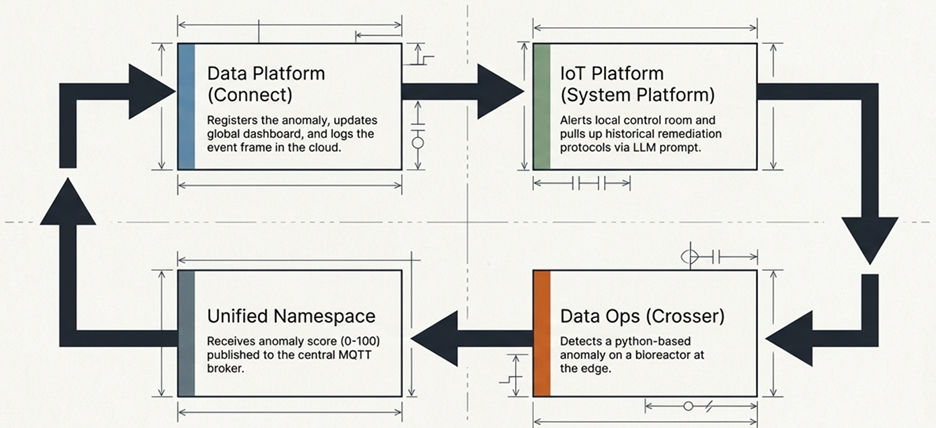
A practical AVEVA-based AI-ready architecture can be understood in three layers.
First, AVEVA System Platform provides the operational foundation. It delivers supervisory control, HMI/SCADA, alarming, visualization, historian capabilities, and a structured asset model. This is where real operations are represented and where operators continue to make critical decisions.
Second, Crosser provides the DataOps and integration layer. It connects data sources, processes data streams, applies transformation logic, supports edge-to-cloud movement, and helps create a more consistent data structure. This is where raw data becomes usable, governed, and ready for higher-level consumption.
Third, CONNECT provides the industrial intelligence layer. It enables secure data sharing, collaboration, visualization, and enterprise-scale access to trusted industrial information. This is where operations data becomes available for analytics, AI, performance management, and cross-functional decision-making.
Together, these layers help customers move from isolated automation systems to an AI-ready industrial architecture.
The SI Opportunity
Customers will need help assessing their existing automation landscape, identifying data gaps, cleaning up tag structures, designing asset models, connecting legacy systems, implementing secure data pipelines, and aligning architecture to business outcomes. They will need guidance on what should remain at the edge, what should move to the cloud, and how to protect operations while enabling innovation. Therefore, they help position the SI as a strategic advisor in the customer’s digital transformation journey.
Omer Qadri is in product marketing for AVEVA.
This content was sponsored by AVEVA.