
Industrial enterprises are operating in a world defined by speed, data, and ongoing transformation — and system integrators sit at the center of making that change possible. Automation, once a behindthescenes utility, is now a strategic enabler of fast, flexible, resilient operations.
Yet many plants still rely on automation systems designed decades ago. These closed, proprietary architectures limit what SIs can deliver: They restrict engineering freedom, slow project execution, and increase longterm support burdens. Integrators are forced to engineer around the limitations of rigid systems instead of designing a solution that best fits the process needs.
Research from Schneider Electric and Omdia, quantifies the challenge:
- Closed systems create hidden costs averaging $11.28M annually
- 3–5 months of time-to-market are lost due to hardware-tied design cycles
- Most organizations run 3–10 hardware platforms, with 30% of issues requiring specialized vendor support
For SIs, this translates into more complexity, more risk, and less time available for innovation.
A Clear Path to Flexible, Future-Ready Automation
Open, software-defined automation (SDA) breaks the historical tie between software and proprietary hardware. For system integrators, this creates a vendor-agnostic, adaptable framework that expands engineering choice and accelerates delivery.
With Open, SDA:
- Automation logic and applications evolve independently of physical equipment
- Updates, expansions, and migrations can be executed without major downtime
- ITgrade technologies integrate seamlessly with OT environments
This opens powerful possibilities for integrators:
- Accelerates project delivery: Reusable, vendor-agnostic components and asset-centric programming cut engineering hours and complexity. Enabling up to 50% savings in engineering time.
- Focus on high-value work: Spend less time on repetitive tasks, more on innovation and data-driven decisions.
- Empower smarter design: Start control design early in the lifecycle, validate changes with Digital Twin, and reduce risk.
- Higher value to end users: Enables digital transformation with IT/OT convergence and interoperability.
- Differentiated offering: Open architecture and hardware independence enables tailored solutions for diverse industries.
EcoStruxure Automation Expert: A Modernization Path That Protects SI Agility
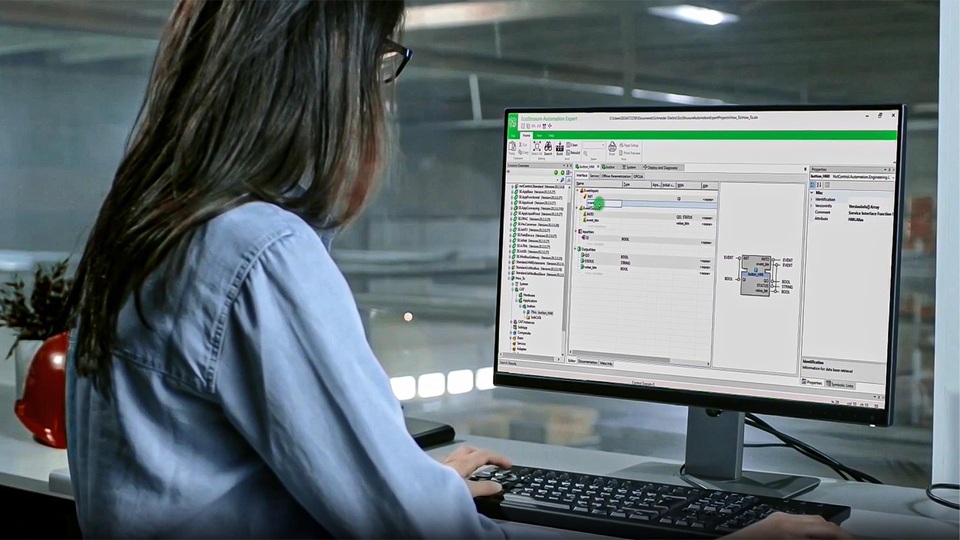
EcoStruxure Automation Expert (EAE) gives system integrators the freedom to choose, flexibility to adapt, and confidence to innovate.
It enables SIs to:
- Modernize customers’ legacy systems without disruption
- Scale architectures confidently across diverse hardware environments
- Deliver solutions that are flexible, maintainable, and futureready
- Unlock new revenue streams by offering advanced analytics, cloud connectivity, and digital services beyond traditional control systems.
Because EAE is designed on the principles of open, software-defined automation, it strengthens SI’s independence by not being restricted to a single vendor while offering customers the potential to choose from an expanding ecosystem of standards-based hardware.
It puts control back in the hands of integrators — allowing them to design, innovate, and adapt based on project needs, not vendor constraints.
Automation That Evolves With Your Customers — and With You
Industrial needs will continue to shift as new technologies emerge, workforce expectations evolve, and sustainability goals accelerate. System integrators need tools that keep them competitive and ready for continuous transformation.
Omdia’s research shows that every quarter organizations delay migrating away from closed ecosystems, they forfeit more than $1M in recoverable value — value that SIs can help unlock.
Open, software-defined automation isn’t just a technology upgrade; it’s a way for integrators to deliver predictable performance today while building adaptable, futureproof solutions for tomorrow.
Photo courtesy of Schneider Electric
This content was sponsored by Schneider Electric.
Sources
Open, Software-Defined Automation
EcoStruxure Automation Expert
Open vs Closed: the $11.28M Question for Industrial leaders