

By Omer Qadri
Industrial operations teams are under pressure to modernize without disrupting what already works.
System integrators and system builders are being asked to deliver projects faster, support more connected architectures, improve cybersecurity posture, and create systems that can scale from edge operations to enterprise-wide visibility.
At the same time, existing HMI and SCADA customers need a practical path forward — one that protects current investments while enabling modernization through web, cloud, and open standards.
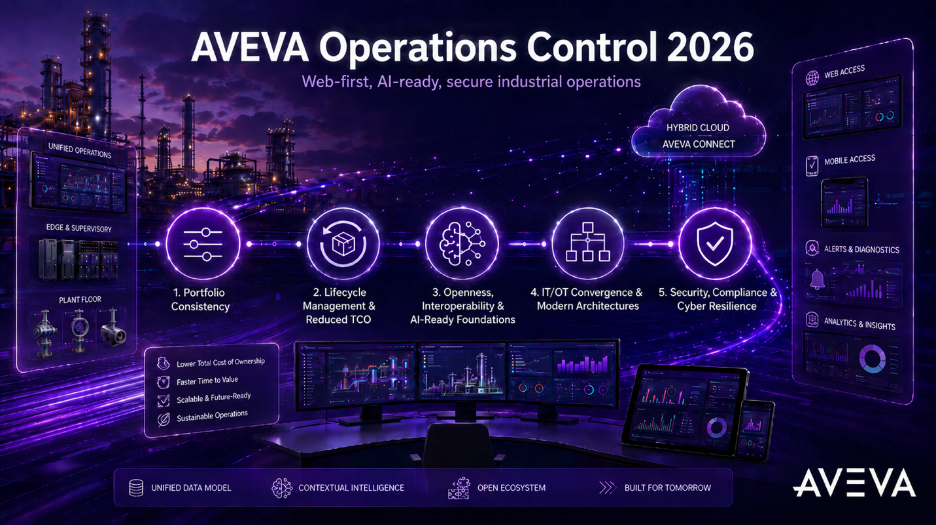
The 2026 release of AVEVA Operations Control advances a hybrid-first approach to industrial automation. The release strengthens the foundation for modern HMI and SCADA systems by improving engineering productivity, web visualization, lifecycle management, cybersecurity resilience, and openness across the operations stack.
Engineering Efficiency at Scale
A major theme in the 2026 release is engineering efficiency at scale. For AVEVA System Platform users, template CSV import and export enables engineers to move configuration data into external tools, make controlled bulk changes, and re-import those changes into the application project. This supports rapid engineering of large template libraries, source-controlled configuration workflows, and AI-assisted validation or generation of attribute sets. For system integrators managing repeatable standards across multiple customers or sites, this creates a more practical way to standardize without manually editing every object in the IDE.
Graphics also become more open and manageable. XML import and export for industrial graphics allows bindings, animations, scripts, and properties to be edited, reviewed, reused, and source controlled outside the IDE. This is especially valuable for teams building large visualization libraries or migrating graphics between templates, instances, and environments. It also creates a foundation for future AI-assisted graphics generation, where external tools can help identify inconsistencies, suggest improvements, or accelerate repetitive engineering tasks.
Modernizing Scripting
The 2026 release also modernizes scripting. Python and C# scripting support is now possible through reusable server-side methods attached to UDT methods in InTouch applications and OMI ViewApp in System Platform. This gives technical teams a cleaner way to centralize logic, reduce script duplication, and run asynchronous methods that do not block the operator interface. For customers modernizing from legacy scripting models, this creates a more maintainable approach to application behavior.
Clearer Path
For existing AVEVA InTouch HMI customers, the 2026 release also creates a clearer modernization path toward web-first visualization. InTouch 2026 advances a common web architecture aligned with System Platform OMI, helping teams move toward more consistent visualization experiences across AVEVA HMI and SCADA products.
Expanded web client capacity, role-based access control, and stronger authentication support help customers extend secure operator access beyond traditional workstation models.
The release also supports conversion of legacy Smart Symbols to modern Industrial Graphics, helping preserve reusable design standards, template behavior, custom properties, and instance-level overrides. For teams with mature InTouch applications, this reduces migration friction and provides a practical bridge from proven legacy applications to modern web-enabled operations.
Connectivity and Openness
Connectivity and openness are also central to the release. Support for publishing the AVEVA System Platform Model View to an MQTT broker enables structured, real-time data sharing with IIoT and enterprise applications. By publishing data in a hierarchical model using lightweight pub/sub messaging, teams can make operational context easier for subscribing systems to understand. This supports Unified Namespace strategies, reduces dependence on traditional polling, and enables more flexible integration with external applications, including analytics and AI-based systems.
Security and Platform Modernization
Security and platform modernization continue to move forward as well. The release includes CRA-aligned security improvements, stronger platform hardening, DCOM removal in favor of gRPC-based communication, and improved system health through Diagnostics Manager. These new capabilities help customers achieve a robust cybersecurity posture, and long-term lifecycle maintainability.
Setting the Stage
Looking ahead, AVEVA Operations Control 2026 also sets the stage for more intelligent operations. With file-based configuration, open data structures, modern scripting, MQTT-based integration, and an upcoming MCP Server follow-on release later in the year, AVEVA is helping industrial teams prepare for a future where AI can assist engineering, diagnostics, operations, and decision support.
For system integrators, the 2026 release provides new tools to build faster, standardize better, and deliver more scalable architectures. For existing AVEVA HMI and SCADA customers, it provides a practical modernization path leveraging AI-enabled workflows.
Omer Qadri is in product marketing for AVEVA.
This content was sponsored by AVEVA.
Image courtesy of Aveva.