

By David Steele
AI has reached the factory floor, opening a new class of opportunity for system integrators: solving complex vision problems that sit beyond the practical limits of traditional machine vision.
What has changed is compute: Modern edge processors can now run sophisticated Vision AI pipelines that understand the physical world in ways that were impractical only a few years ago.
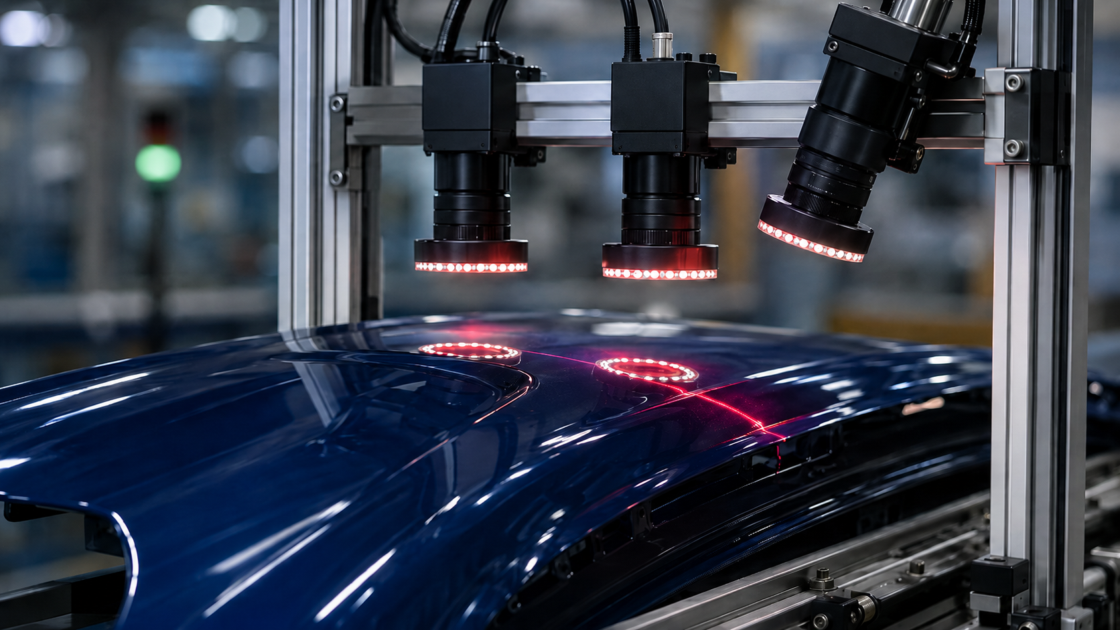
While traditional machine vision has largely solved deterministic inspection tasks, the greatest opportunity now lies in applications where appearance varies more than geometry. These include reflective surfaces, natural materials, deformable products, and rapidly changing SKUs. They are often the inspection tasks that remain manual, generate high false-reject rates, or require frequent recalibration to maintain performance.
The Opportunity for System Integrators
The Manufacturing Leadership Council’s 2026 Smart Factories and Digital Production Survey found that 76 percent of manufacturers now operate vision systems in production, while 66 percent have adopted machine learning.
Deloitte’s 2025 Smart Manufacturing Survey reported measurable gains, with output increasing by up to 20 percent, worker productivity by up to 20 percent and production capacity by up to 15 percent.
The demand is clear, but adoption among small and mid-sized system integrators continues to be limited by two challenges: accessing and applying specialized Vision AI expertise and sustaining those systems once they are deployed.
System integrators already bring deep knowledge of manufacturing environments, strong vendor relationships and the expertise to design, integrate and commission automation systems. What many lack is access to the specialized Vision AI expertise and lifecycle software required to build, deploy, and continuously improve a system.
Platforms such as AcuSight by BrinqAI bridge this gap by providing a fully on-premises Vision AI platform with performance dashboards, model adaptation workflows, audit-ready data, integrations, and edge-native deployment. Combined with BrinqAI’s data science expertise, this approach accelerates the path for system integrators to deploy Vision AI solutions and provides the tools to sustain them.
Where Traditional Vision Stops
The difference between traditional machine vision and Vision AI lies in the architecture. Rather than reducing an inspection problem to a fixed set of rules, Vision AI combines sensors, models and processing stages into a pipeline designed for the application. This provides four key advantages.
- Scalability. Vision AI starts with the physics of the inspection problem and applies the sensing modality best suited to solve it. A scratch that is invisible in a conventional RGB image may become obvious using a polarized image sensor, while other applications may benefit from 3D, infrared or thermal sensing. Vision AI pipelines can scale to combine multiple sensors, models, and algorithms to solve increasingly complex inspection problems.
- Classify, don’t just pass or fail. Instead of returning a binary decision, Vision AI can classify multiple product attributes simultaneously. This produces richer operational data that can help to identify upstream process issues, reduce false rejects, and improve manufacturing decisions.
- Right-size the hardware. Traditional vision systems tightly couple the camera and processing hardware. Vision AI separates image capture from edge compute, allowing cameras, processors, and connectivity to be selected independently while using a common software platform (like AcuSight) across different hardware configurations.
- Operationalize vision. Vision AI learns from real-world variability, including changes in products, materials, and operating conditions. Operationalizing that capability through model management, adaptation and performance monitoring allows inspection systems to evolve alongside production rather than requiring periodic re-engineering.
| Traditional Machine Vision | Vision AI (AcuSight by BrinqAI) |
| Fixed rules and a golden template | Models trained on application-specific data |
| Binary pass/fail decisions | Multi-class classification of defects and product attributes |
| Single RGB camera | Multi-sensor pipelines (RGB, 3D, infrared, polarization, thermal) |
| Camera and processing tightly coupled | Cameras, sensors, and edge compute selected independently |
| Static after commissioning | Continuously adapts as products and processes evolve |
| Best suited for predictable inspection | Built to accommodate real-world variability |
Applications and ROI
For system integrators, the greatest opportunities lie in applications where Vision AI complements traditional machine vision by addressing inspection and operational challenges that were previously difficult or uneconomical to automate. Selecting the right starting point is key, as successful Vision AI deployments typically fall into three categories:
- Surface inspection. Addresses products where reflection, deformation, or natural material variation challenge traditional vision systems. Common applications include reflective metals, glossy plastics, deformable films, woven textiles, wood, stone, and other composite materials.
- Package inspection. Verifies package contents, seal integrity, package condition, print and surface quality, complex multi-component labels or compliance markings and physical damage across a wide range of package types.
- Production intelligence. Extends beyond product inspection to provide operational visibility across the manufacturing process. Applications include product tracking and visual re-identification for traceability, line clearance, operator activity, PPE compliance, workflow verification, and production monitoring.
Once a suitable application has been identified, the fastest path to ROI is to begin with a single pilot, typically one with a significant manual inspection component. Deploy the Vision AI system in shadow mode and measure improvements in labor, quality, false rejects, rework, and downtime. Once validated, deploy the system into production and integrate it with existing OT and IT infrastructure to extend its value beyond the inspection station.
BrinqAI Case Study: Line Clearance at a Pharmaceutical PlantBrinqAI Case Study: Line Clearance at a Pharmaceutical Plant
BrinqAI helps system integrators solve complex Vision AI challenges in two ways. First, the data science team works alongside integrators to develop custom Vision AI pipelines, training application-specific models and selecting the appropriate sensors and edge hardware for the inspection task.
Second, once deployed, AcuSight, the on-premises software platform, provides the tools to operationalize those systems through performance dashboards, model adaptation, software orchestration, device management, and IT/OT integrations.
This combination enables integrators to accelerate deployment while providing manufacturers with a sustainable platform that can adapt as production requirements evolve.
A recent project illustrates the approach. BrinqAI collaborated with 42 Technology, Synaptics and Balluff to develop an automated line clearance solution for a pharmaceutical manufacturer. The process of line clearance verifies that equipment, work areas, and materials are free from residual product before the next production run begins, a process traditionally performed manually using paper checklists.
By combining multiple cameras with Vision AI analytics to identify contaminants and production anomalies across the production line, the solution reduced changeover time by up to 85 percent and achieved payback in less than nine months on the initial deployment.
The result was a measurable business case: faster changeovers, reduced downtime, improved compliance, and a digital, audit-ready record of every line clearance.
The Business Case for the Integrator
For integrators, partnering with a specialized Vision AI company such as BrinqAI makes both commercial and strategic sense. It provides access to the expertise, tools and software required to deliver advanced Vision AI solutions without the internal investment. This lowers the barrier to entry while enabling integrators to pursue more complex, higher-value inspection opportunities.
- Expand project opportunities. Pursue applications that extend beyond the practical limits of traditional machine vision and grow successful deployments from a single production line to additional lines and facilities.
- Accelerate customer ROI. Deploy pilots in weeks rather than months, demonstrating measurable operational improvements that support broader production rollouts.
- Reduce technical risk. Access specialized Vision AI expertise without building and maintaining an in-house data science or machine learning team.
- Create new revenue opportunities. Model adaptation, system monitoring, lifecycle management, and new inspection applications create long-term service opportunities beyond the initial deployment while strengthening customer relationships.
Your automation expertise. BrinqAI’s platform. Together, a complete industrial AI solution. Start the conversation at brinqai.com/book-demo.
David Steele is the CEO of BrinqAI, where he works with system integrators and manufacturers to take complex vision applications from feasibility to production. BrinqAI pairs application-specific Vision AI pipelines with AcuSight, its on-premises platform for operationalizing and sustaining inspection systems on the factory floor.
This content was sponsored by BrinqAI.
Photo courtesy of BrinqAI.