

By Mary Anne Ballouz
At the Centre for Advanced Laser Applications (CALA) in Garching, Germany, advanced laser systems help researchers explore new possibilities for cancer detection, biomedical imaging, and particle-beam therapy.
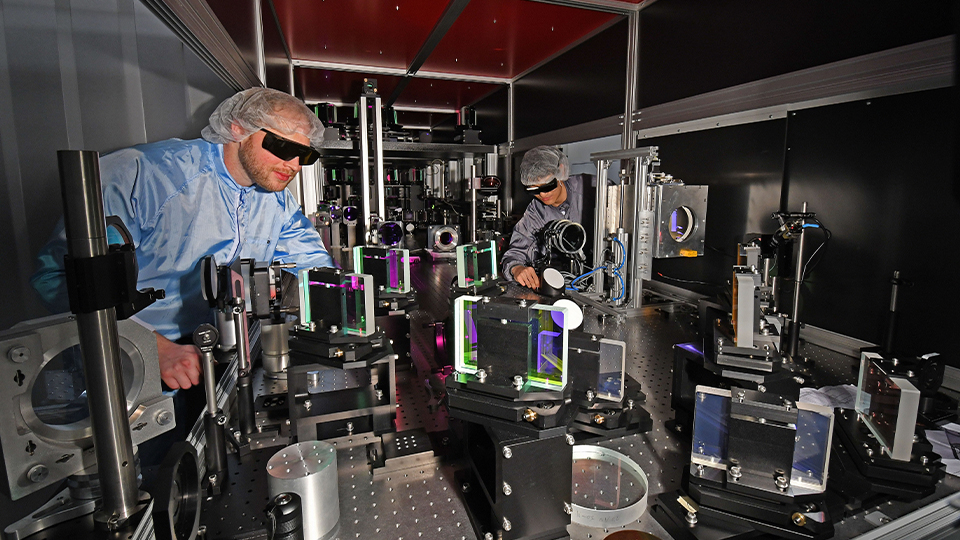
Inside the facility’s shielded experimental “caves,” high-intensity laser beams travel through evacuated tubes and precisely aligned mirror systems toward experiments where even small operational errors can carry major consequences.
Managing this environment requires far more than traditional facility automation.
Researchers, engineers, safety systems, laser infrastructure, and experimental stations must operate in perfect coordination. Multiple research teams may work simultaneously, while ionizing radiation risks and complex beam-routing requirements demand strict access control, real-time visibility, and complete operational transparency.
To solve this challenge, CALA partnered with German system integrator (SI) MESALOGIC to design and implement a centralized control and safety environment built on GENESIS, the automation and digitalization platform from Mitsubishi Electric Iconics Digital Solutions.
CALA selected MESALOGIC because of the company’s expertise in network infrastructure, SCADA, remote alarm management, and advanced visualization and control systems, as well as its extensive experience integrating the GENESIS platform.
GENESIS aligned well with CALA’s requirements by combining:
- Centralized visualization
- HTML5-based interfaces
- Real-time operational transparency
- Comprehensive data logging
- Scalable architecture supporting multiple experimental environments
These capabilities were critical for operational coordination, safety controls, and traceability.
MESALOGIC Built a Centralized Control and Safety Environment for CALA
Unlike conventional industrial environments, CALA’s laser systems are physically separated from the experimental stations where the work occurs. Laser beams travel through sophisticated vacuum tube systems equipped with adjustable mirrors that direct the beam toward the selected cave. Precision alignment is critical, and access to active experimental areas must be tightly controlled to protect researchers and operators from unsafe conditions.
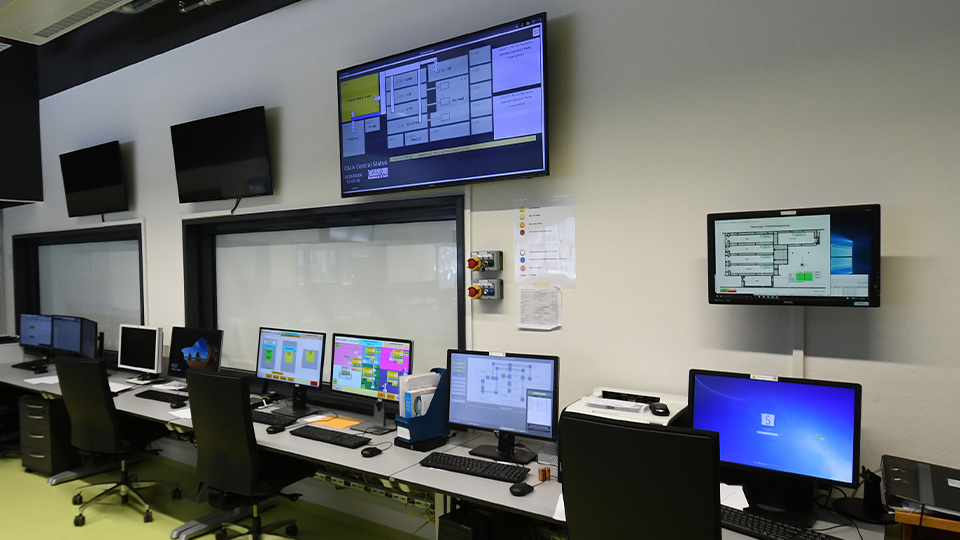
MESALOGIC developed an HTML5-based visualization and control environment fully integrated with GENESIS, allowing operators to monitor and manage the entire facility from a centralized control center. Large-format displays and cave-level dashboards provide continuous visibility into laser activity, cave status, safety interlocks, and operational conditions across the facility.
The system introduced several intelligent operational safeguards and coordination capabilities, including:
- Automatic access restrictions when lasers or experimental caves are active
- Prevention of conflicting operations between simultaneous research teams
- Real-time visibility into cave status, laser activity, and safety interlocks
- Centralized monitoring and control across the entire facility
- Full audit trails for mirror configurations, setpoints, timestamps, and user actions
If one laser system is logged into an experimental station, other systems are automatically locked out. This coordination mechanism allows multiple project teams to operate simultaneously while maintaining strict safety separation between experiments.
Every operational parameter, including mirror configurations, experimental setpoints, timestamps, and user actions, is logged through the platform to create a complete audit trail. Researchers can later retrieve comparative values, validate experiment configurations, and analyze previous operating conditions with precision.
The architecture also reflects a growing trend within advanced industrial and research environments, combining:
- Web-based visualization
- Centralized operational intelligence
- Scalable system integration
- Real-time KPI dashboards
- Browser-based access across the facility
Industrial PCs mounted at each experimental cave provide local dashboards with real-time updates, while the browser-based interface allows the environment to evolve alongside future research requirements without requiring major client-side software deployment.
Centralized Industrial Automation and Safety Systems Support High-Stakes Research Environments
The project demonstrates how modern system integrators increasingly operate at the intersection of operational technology, safety engineering, visualization, and data-driven decision-making.
For Control System Integrators Association members, the CALA project highlights how the role of the system integrator continues to evolve far beyond traditional controls implementation. Projects increasingly require multidisciplinary expertise spanning safety systems, human-machine interaction, real-time operational visibility, cybersecurity, scalable architecture, and complex coordination across distributed technical environments.
At CALA, success was not defined simply by automation performance. Success depended on creating a safe, transparent, and highly coordinated environment for advanced laser research.
Read the full CALA success story here.
Explore additional system integrator and customer success stories from Mitsubishi Electric Iconics Digital Solutions.
Mary Anne Ballouz is the Content Marketing Manager for Mitsubishi Electric Iconics Digital Solutions. With a background in engineering (B.Sc., M.Sc.), university-level English teaching, and global experience in content strategy, writing, editing, and storytelling, she specializes in transforming complex technical concepts into clear, engaging content that informs, inspires, and drives action across diverse audiences.
This content was sponsored by Mitsubishi Electric Iconics Digital Solutions.